THE SHORT VERSION
Depression treatment, innovative, cutting-edge, personalized
Use your insurance
In-network with all major Vermont insurers.
Non-invasive
You're awake throughout, no medication or anesthetic required, no restrictions on driving, no limitations on your typical daily activities.
Experience precision psychiatry
Cutting-edge treatments targeted to brain circuits associated with various disorders.
Community-based care
Experience care in a community-based clinic. In our model, we focus on the individual and deliver tailored treatments in a multidisciplinary, team-based, collaborative environment.
Standard TMS at State Street, in brief
What it is
The Standard protocol is FDA-approved to treat recurrent, treatment refractory, major depressive disorder.
What happens
You will undergo screening and evaluation to determine if you meet criteria based on your insurance policy coverage. In general, most insurance plans require failure of 2-4 antidepressant medication trials, or inability to tolerate antidepressant medications. If you require a prior authorization, one will be submitted on your behalf. Currently in Vermont no prior authorization is required for those who meet criteria for, Medicaid, Medicare and Cigna.
How long it takes
The Standard protocol is 36 sessions, administered in our office Monday-Friday. Sessions can consist of either a 3 minute theta burst (iTBS), or a 19 minute conventional (rTMS). Typically, treatment is five days per week and lasts 4-8 weeks. BCBSVT currently allows two treatments per day which can shorten treatment length.
The standard protocol: this is the on-label, insurance-covered protocol for depression. If seven to eight weeks isn't workable for you, our various accelerated protocols can condense treatment into as few as six days.
THE TREATMENT
What standard TMS involves
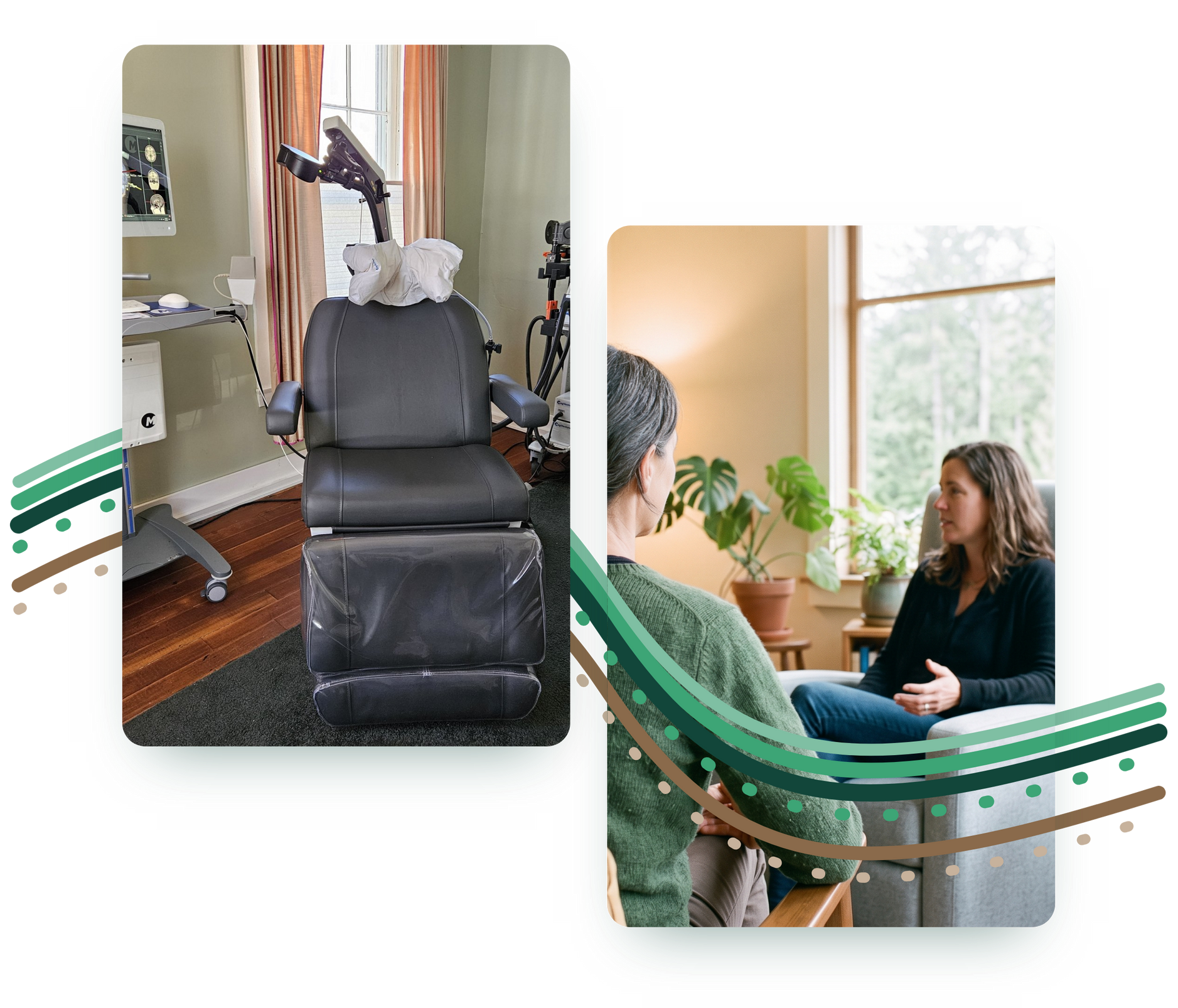
Standard TMS is a non-invasive treatment. A small coil rests against your head and sends focused magnetic pulses which create an electrical field and activate the circuits of the brain associated with various psychiatric and medical conditions. Treatment is targeted to the circuits in the brain that help regulate the condition you are being treated for; the location varies by treatment protocol.
One of the many benefits of this approach is that it does not require medication, therefore it does not carry the systemic side effects that can be associated with medication treatment.

Time in the chair
3-19min
A session can take three to nineteen minutes
Theta burst stimulation (iTBS) uses shorter, higher-frequency bursts: a conventional session runs 19 minutes, a theta burst session runs 3 minutes. Theta burst treatments may be utilized based on clinician recommendation, patient convenience with shorter appointment time, or when additional treatments are selected for customization.
*BCBSVT will approve two units per day of the standard protocol which can be the 3min theta burst or the 19min session, this can shorten the course to around four weeks.
Cost and coverage
What it costs
Standard TMS for depression is covered by all major insurance payers in Vermont, and we are in-network. What you pay depends on your individual plan and can involve meeting a deductible, a copay or coinsurance. We verify your benefits and give you an estimated cost before treatment starts.
We understand that cost associated with these treatments may present a challenge. We are committed to a flexible and transparent financing model. Individual financial circumstances are considered upon request.
Covered by insurance
Cash pay
*Vermont Medicaid (Green Mountain Care) covers 100% of treatment, no copay, no deductible. Eligible patients can get started right away.

Your clinicians
You're in expert hands
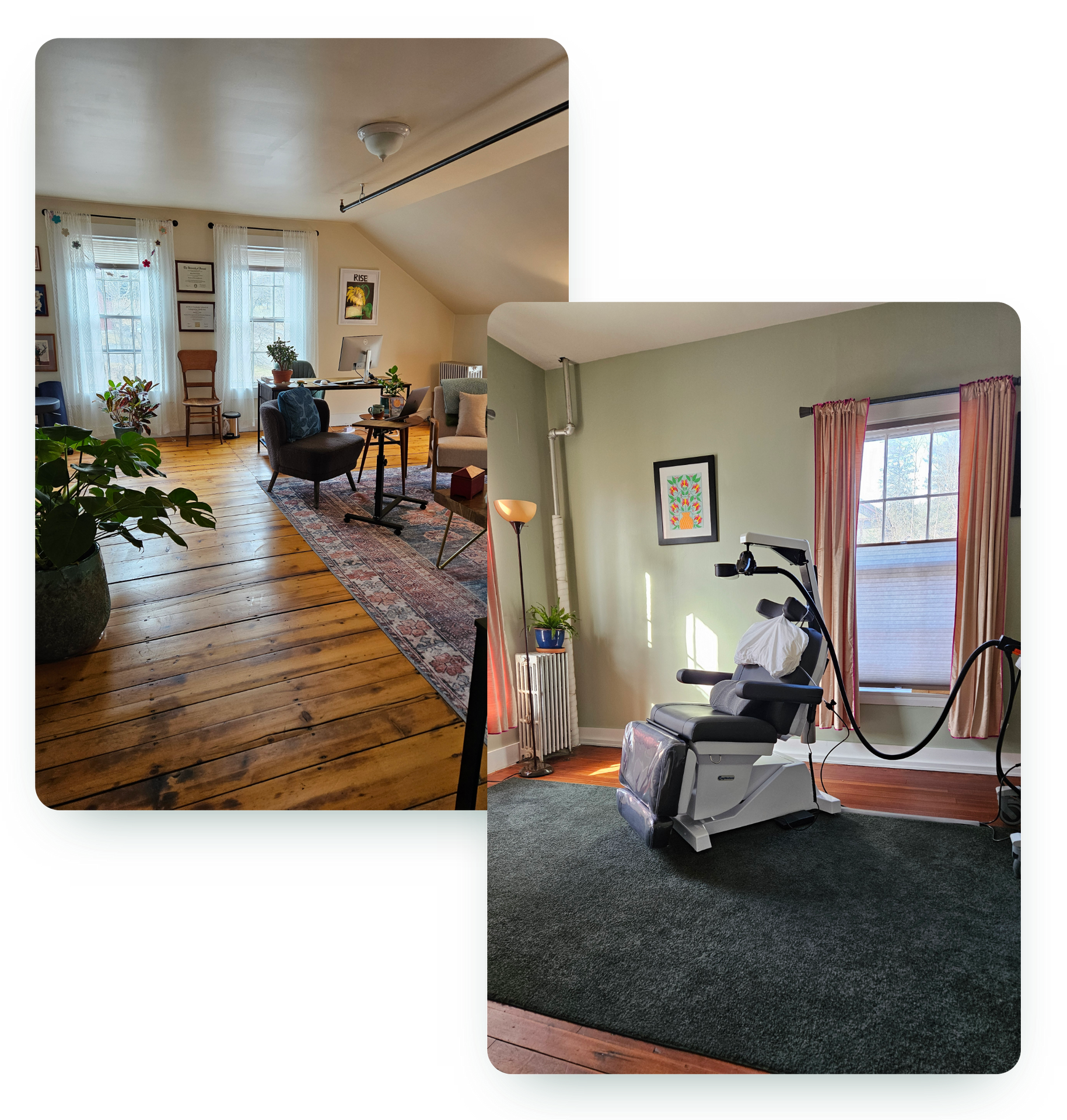
State Street TMS offers a comprehensive approach to your health and wellness. As an independent, clinician-owned, and community-based practice, we set ourselves apart by moving beyond standard treatment to deliver highly customized, personalized care in a welcoming, comfortable environment.
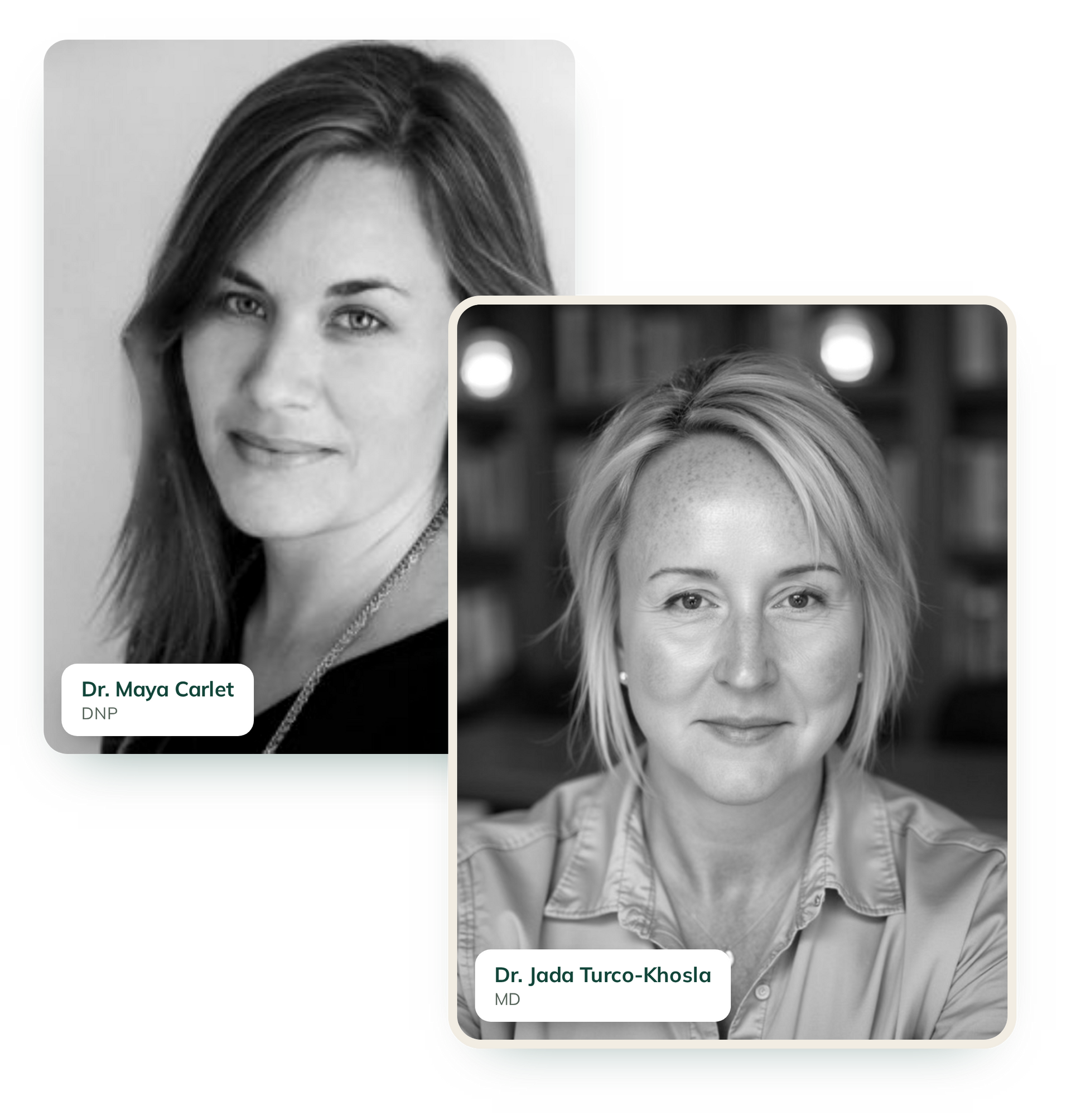
What truly distinguishes our practice is the combined, multidisciplinary expertise of Dr. Jada Turco-Khosla, MD, and Dr. Maya Carlet, DNP. Together, we blend integrative psychiatry, specialized medicine, metaphysics, and advanced precision neuro-interventions. Rather than a one-size-fits-all approach, your evaluation and treatment are tailored to support you as a whole being, with thorough, compassionate guidance at every step of your care.
She told me that my voice sounded “brighter”
At age 67, after requiring medicine for depression for about 35 years, I feel blessed to have discovered State Street TMS. I had taken just about every SSRI and SNRI available and ALWAYS at some point I felt like my brain would become reticent to the effect of the drug… I was done with this pharmaceutical merry-go-round and THANKFULLY transcranial magnetic therapy worked!
Every single day I am grateful to all the staff at State Street TMS. The atmosphere felt warm, inviting, and comfortable and the staff always did their best to accommodate any scheduling changes I needed. The best testimonial I received was from a lifetime friend whom I haven't physically seen for 6 years… she told me that my voice sounded “brighter” when we telephoned over the holidays!
Lallie M · Google review
How it works
From inquiry to final session
Clinical referrals can be made directly through the Referral Form. Individuals seeking treatment for themselves or a family member can Request an Appointment to fill out a brief Intake Form. After the Referral or Intake Form is submitted, we'll reach out to you within 24 business hours with next steps.
Takes two minutes
Following the Intake Screening, individuals meeting criteria will be scheduled for a comprehensive and personalized clinical evaluation with either Jada Turco Khosla, MD or Maya Carlet, DNP. As a part of the evalutaion process we will discuss your individual verified insurance coverage and any potential out-of-pocket costs including deductible, copay or coinsurance.

Your cost, confirmed upfront
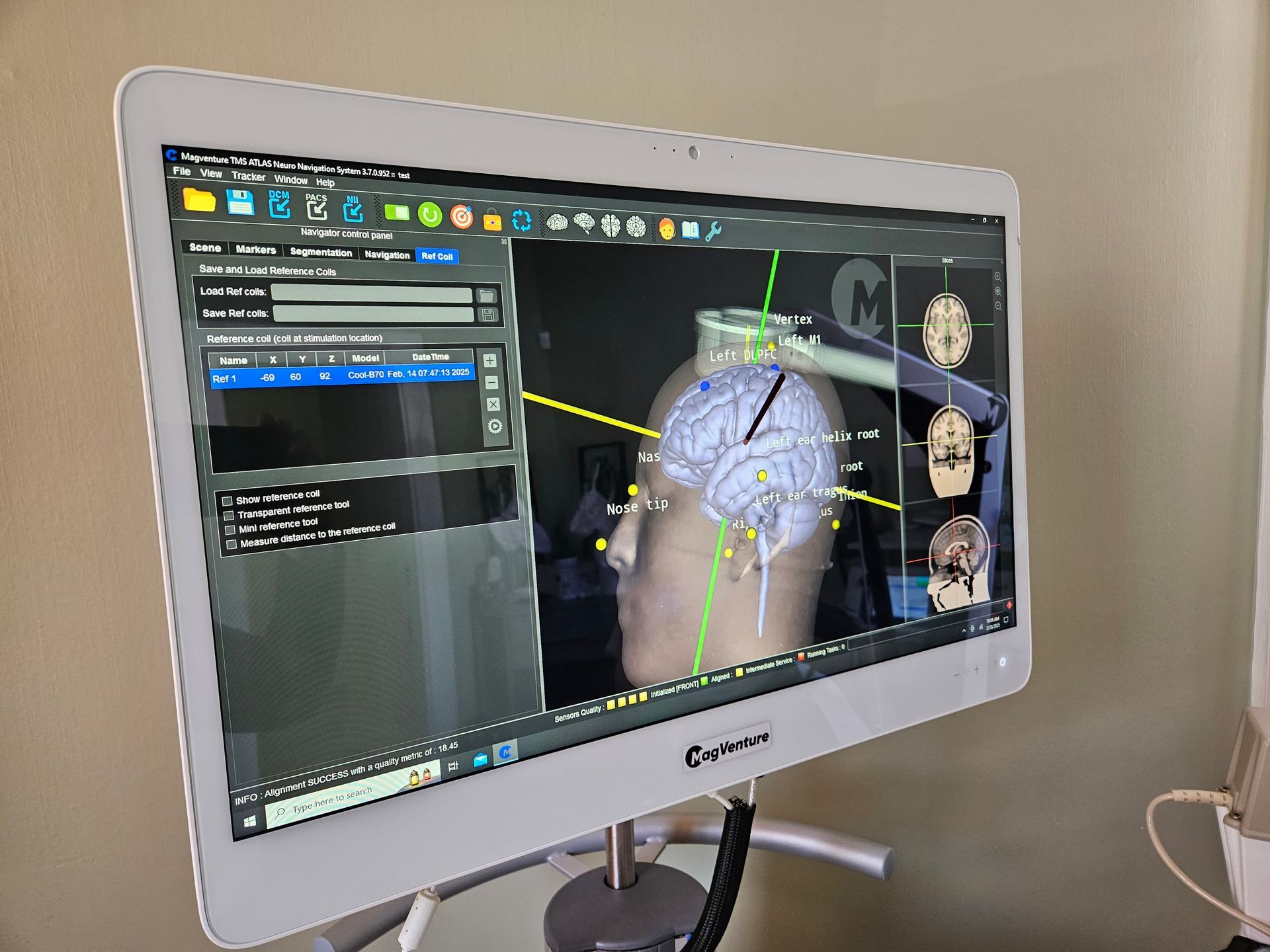
During your first session we establish your treatment "dose" by stimulating your motor threshold. We use neuronavigation (MRI, fMRI, or MNI coordinates) or modified beam calculations to locate your exact coil position, and you receive your first treatment.
Neuronavigated targeting
Daily sessions are anywhere from 3 to 19 minutes, five days a week, for approximately 8 weeks (can be as short as 4 weeks with BCBSVT). During treatment you'll be in a comfortable treatment chair, you'll hear a clicking sound and feel a tapping sensation on your scalp. Most people watch TV, listen to music, or rest quietly. Then they leave and get on with the day.
Three minutes in the chair
Following your treatment protocol, you will continue to notice improvements and changes over the next 12 weeks. During that time, your team may recommend additional treatments or services aimed at improving neuroplasticity and optimizing your outcome. Your team will also track your response through outcome measures and clinical follow-up. Considerations for maintenence treatment sessions are on-going with your treatment team.
Reviewed as you go
Takes two minutes
Your cost, confirmed upfront
Neuronavigated targeting
Three minutes in the chair
Reviewed as you go
The timeline for the entire process, from your first inquiry to the start of TMS treatment, can vary depending on your insurance and schedule availability, but in general it's 2–3 weeks from inquiry to start of treatment.
THE EQUIPMENT
The system we treat with

Atlas neuronavigation
Your coil position, mapped to your own anatomy
Rather than estimating a spot on the scalp, neuronavigation guides the coil to the same mapped target every session.
WHO'S IT FOR
Is standard TMS a fit?
Adults and adolescents (15–17 yrs) whose depression hasn't improved enough on medication.
- Antidepressants have helped, but not enough
- Side effects have made medication hard to stay on
- You'd rather not take something every day
- You need a treatment with no recovery time
- You have a history of seizures or epilepsy
- You have metal implants or devices in or near your head
- You have a cochlear implant, deep brain stimulator or aneurysm clip
- You have any other safety considerations that may affect TMS treatment
We screen for all of this before anything is scheduled. If TMS isn't the right treatment for you, we'll tell you.
Questions
What people ask before they call
Will my insurance cover this?
Most major Vermont payers cover standard TMS for major depressive disorder, and we're in-network with them. We check your specific benefits before treatment starts and tell you what your share will be.
How long before I feel different?
Most people who respond notice something between the second and fourth week. It's often gradual, and other people sometimes spot it before you do. The advice is to finish the full course before assessing for results. The research also indicates that brain networking continues to improve for 12 weeks following the end of treatment, which means the fullest benefits may be noticed a few months after you have completed your protocol.
Does it hurt?
Most people describe a tapping sensation on the scalp that's uncomfortable for the first few sessions and then stops registering. Some get a mild headache early on, which usually settles and is easily managed with over-the-counter pain relievers like ibuprofen or acetaminophen.
Do I have to stop my medication?
No. In fact, we recommend that as much as possible there be no changes to medication during TMS treatment. That said, any changes are a clinical decision made between you and your prescriber.
Is this the same as ECT (shock therapy)?
No. ECT requires general anesthesia and induces a seizure. TMS uses focused magnetic pulses while you're awake, needs no anesthetic, and has no recovery period.
Seven weeks is a lot of driving. Is there another option?
That's the most common objection we hear, and it's a fair one. Our accelerated protocol delivers treatment over six days rather than seven or eight weeks. It isn't covered by insurance, but for people traveling from further out, it often works out as the more practical route.
Do you treat OCD with the standard protocol?
We also offer a dedicated protocol for OCD; please see our OCD page for details.

WHY US
Why State Street TMS
Six reasons people choose us.
What happens next
Ready to talk it through?
Request an appointment, and we'll arrange your evaluation and check your insurance so you know where you stand before committing to anything.